This Suzuki Ad Was Banned in Italy – Because of Orwell and Girls on Motorcycles (7 photos)
In the early 1970s, Italian photographer Franco Turcati shot two advertising campaigns for Suzuki that caused a stir. The first was accused of sexism and banned. The second was so bland that the Japanese headquarters decided to drop the topic altogether. We tell how motorcycles, Orwell, and late-night billboard stickers made Turcati part of Italian advertising history. 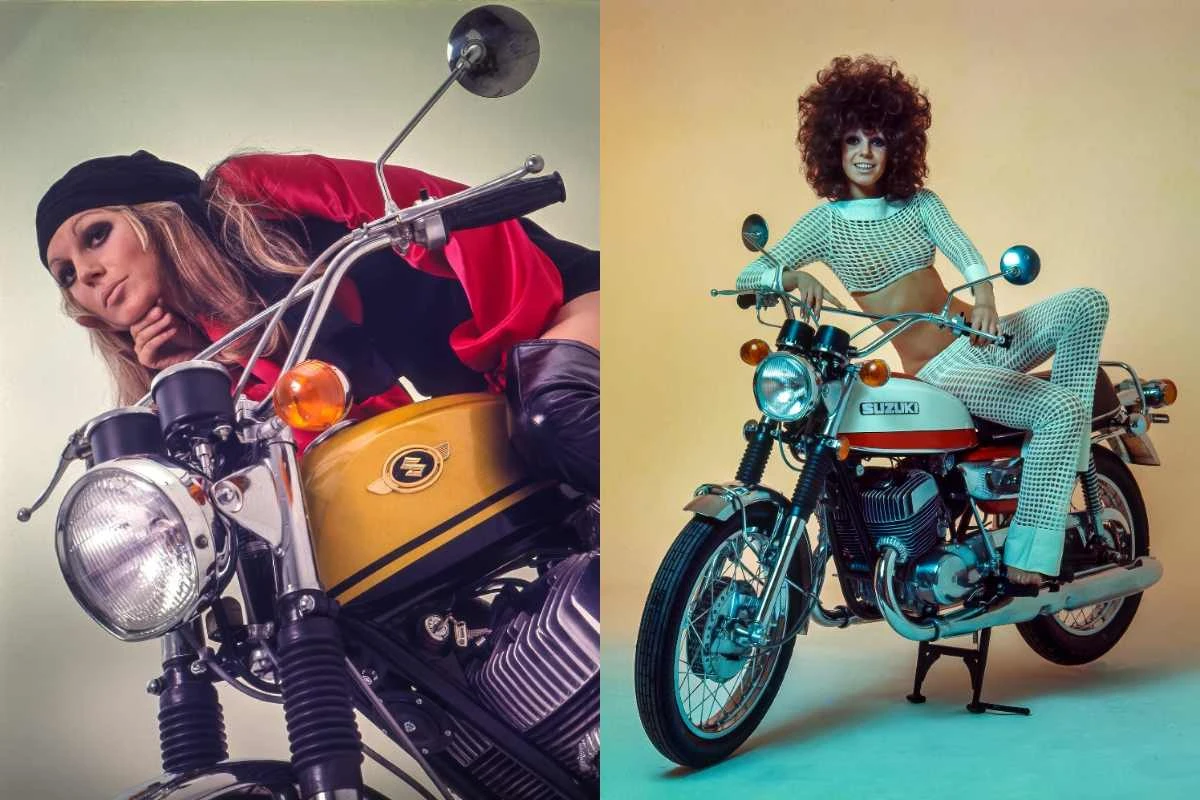
Photographer, dealer, and Japanese man on a motorcycle
Franco Turcati shot an ad for the Turin car dealership Monzeglio. In the early 1970s, he became one of the first Italian importers of Suzuki motorcycles. This is where the most scandalous advertising campaigns in the history of the Italian motorcycle industry began.
The path to Suzuki was paved by Japanese Hideyuki Miyakawa. He arrived in Italy on a motorcycle, married Turin-born Maria Luisa Bassano, and acted as a go-between for Monzeglio and Suzuki. He later became the right-hand man of the famous car designer Giorgetto Giugiaro. According to Turcati, Giugiaro was an exceptionally gifted man. 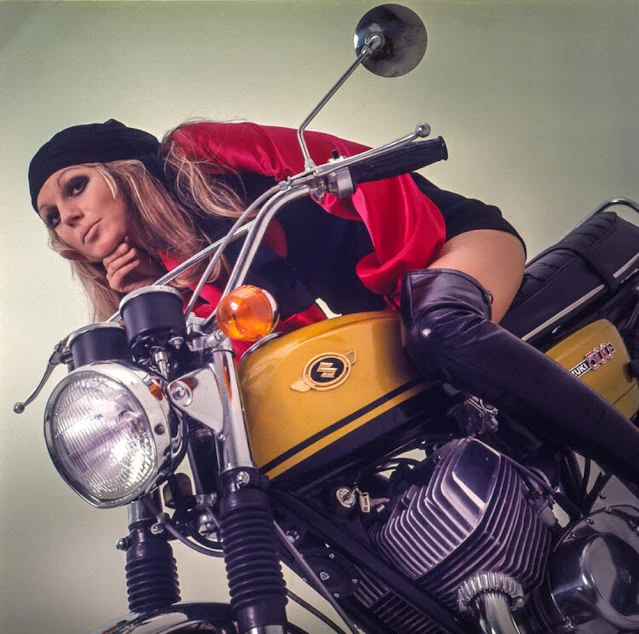
Turcati's first campaign for Suzuki was shot in 1965 with a Nikon F camera.
In 1965, Turcati shot Suzuki's first Italian advertising campaigns. He was holding a Nikon F with a 300mm telephoto lens, borrowed from Quattroruote magazine. He didn't yet know that these images would go down in history.
"I am Suzuki, and you?" - Fashion and Motorcycles
The first campaign was called "Io Suzuki e Tu?" - "I am Suzuki, and you?". The shots featured motorcycles and women: a typical male gaze of the era. Turcati's young friend, Leah Dezman, modeled the campaign. She wore a curly wig, knee-high vinyl boots, and sheer knit tops. The campaign perfectly captured the transitional moment in late 1960s fashion. 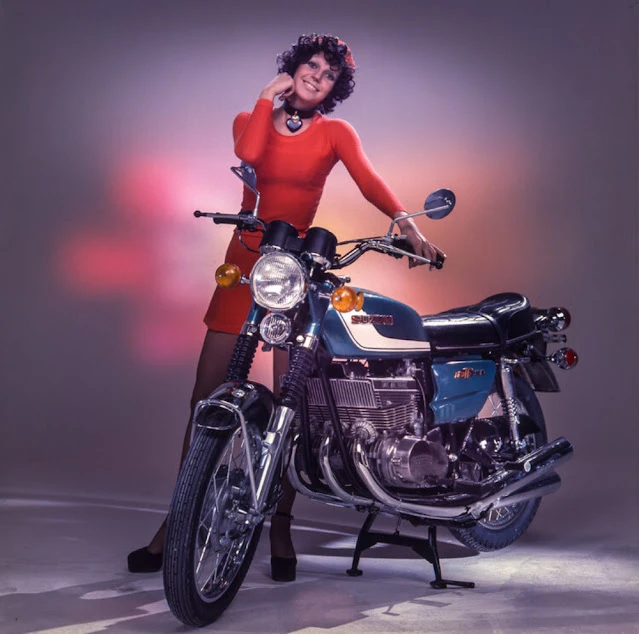

Model Leah Dezman posed for several Suzuki campaigns.
The style of the shoots reflected the spirit of the times. Fashion was changing rapidly: miniskirts gave way to maxi skirts, synthetics became commonplace, and vinyl boots became a symbol of the era. Turcati had a knack for capturing this. The campaign was a success, but the next one surpassed it in scandal.
Orwell, sexism, and the first ban in the history of Italian advertising
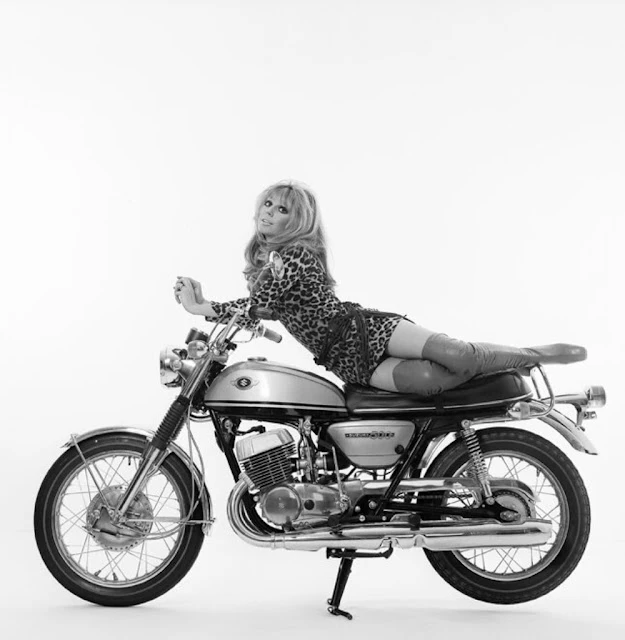
The slogan for the new campaign was written by advertising artist Wilma Cino. It was inspired by George Orwell and his "Animal Farm." The campaign was titled "Donne e moto sono tutte uguali, ma qualcuna è più uguale" — "All women and motorcycles are equal, but some are more equal."
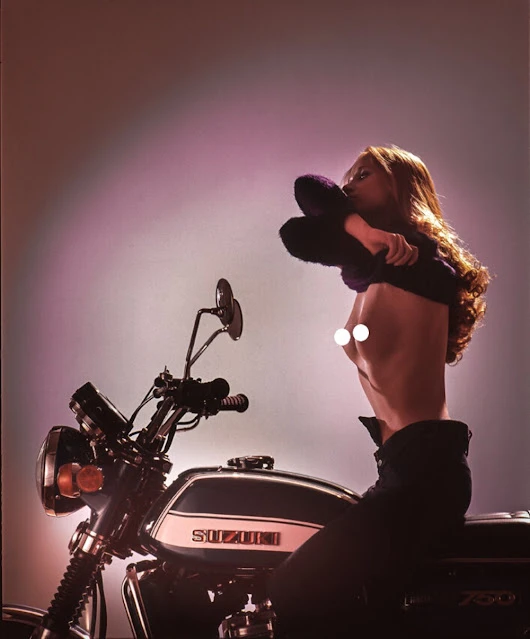
This photograph was part of Suzuki's most controversial campaign in Italy.
This was the first advertisement in Italy officially condemned by the Institute for Advertising Self-Discipline (Istituto di Autodisciplina Pubblicitaria). The organization had just been created. The advertisement was accused of sexism, despite the fact that the slogan was written by a woman and quoted a classic.
The scandal raged on several fronts. Around the same time, photographer Oliviero Toscani shot an advertisement for Jesus jeans, featuring close-ups of women's buttocks. Both campaigns were attacked by Angelo Pezzana, the founder of FUORI, Italy's first gay rights movement. At night, his people would stick huge stickers on billboards: "This advertisement insults women."
Meeting in Sicily and a Change of Course
Turcati met Pezzana by chance in Sicily, many years later. Pezzana spoke of his nightly protests with pride. Turcati recalled: “The times were strange and vibrant.”
The "Steel Island" campaign was filmed on the beach of Forte dei Marmi.
Under pressure, Suzuki changed its strategy. The new campaign, "Suzuki Isola D'Acciaio," or "Steel Island," was filmed on the beach of Forte dei Marmi. The imagery was futuristic, but it failed to resonate. The Japanese headquarters decided on more restraint. The contract was transferred to the Milan agency OPIT.
Monza and the End of an Era
The new campaign was filmed at the Monza circuit. Turcati's assessment was blunt: insignificant. When an agency compromises with a client, creativity vanishes.
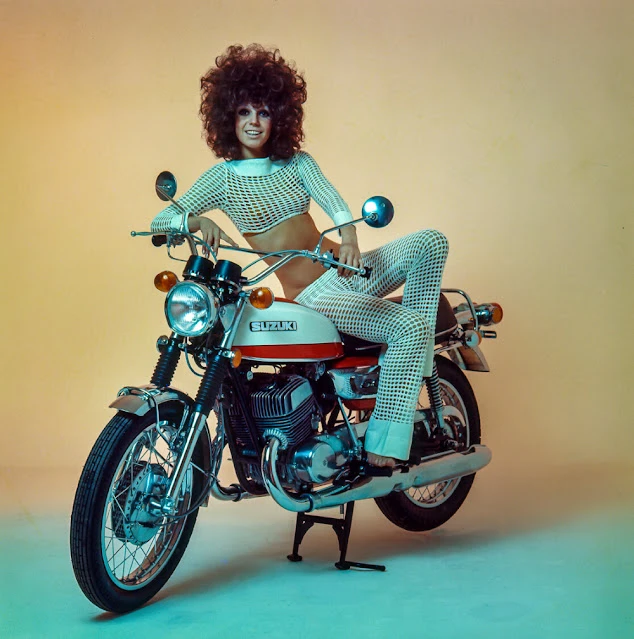
Transparent knitted outfits are one of the main images of Turcati's campaigns.
After Turcati's experiments, motorcycle advertising became increasingly vulgar and tasteless. The computer age opened the market to those with no sense of typography or design. Dialogue with strong art directors disappeared—along with the professional growth it provided.
The Legacy of Scandal
Turcati's campaigns for Suzuki are a document of the era. They reveal the advertising language of the late 1960s and early 1970s: provocative, vibrant, balancing fashion and scandal. The ban didn't kill the campaign—it made it famous. Competitors Honda, Kawasaki, Laverda, and Guzzi could only watch as Suzuki reaped free front-page media space.
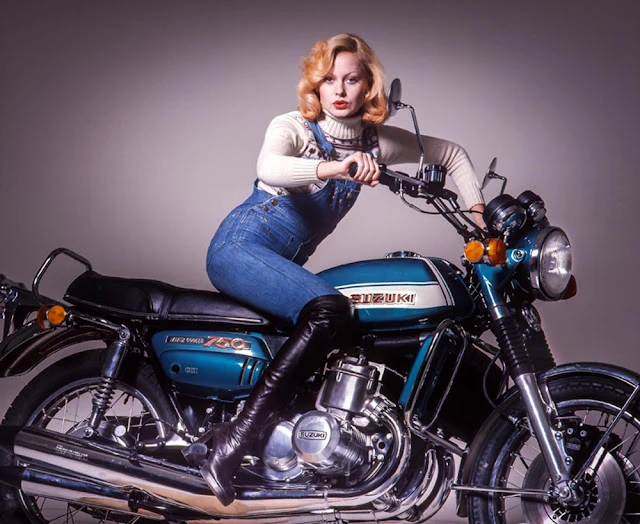
A Suzuki 750 surrounded by the fashion of its time—1970s jeans and denim.
The question remains: where is the line between provocation and taste in advertising—and does it even exist? Tell us in the comments which campaign you think is stronger.

Download
Archive size 658.61 Kb, downloaded 11 times