The artist who coined the word "happening": how Allan Kaprow turned a tire dump and a wall of bread into art (19 works)
Allan Kaprow (1927–2006) coined a word that is now known in every language. He called a wall of bread, a pile of old tires, and a house of ice melting in the sun art. His works were impossible to buy, hang on a wall, or place on a shelf. We explain how a modest Rutgers University professor changed everything we know about art—and why his most important invention ultimately spiraled out of control. 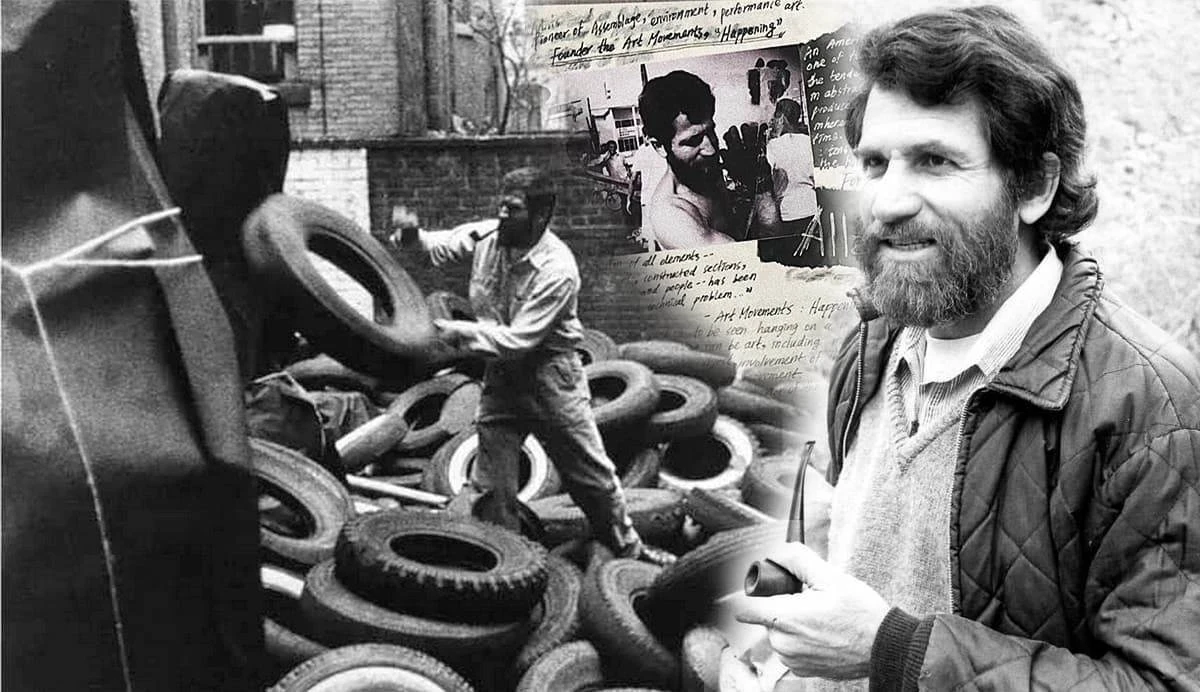
From Canvas to "Concrete Art"
Allan Kaprow was born on August 23, 1927, in Atlantic City, New Jersey. His family was ordinary, far from artistic. But Allan himself drew from childhood and dreamed of becoming an artist. His dream came true. 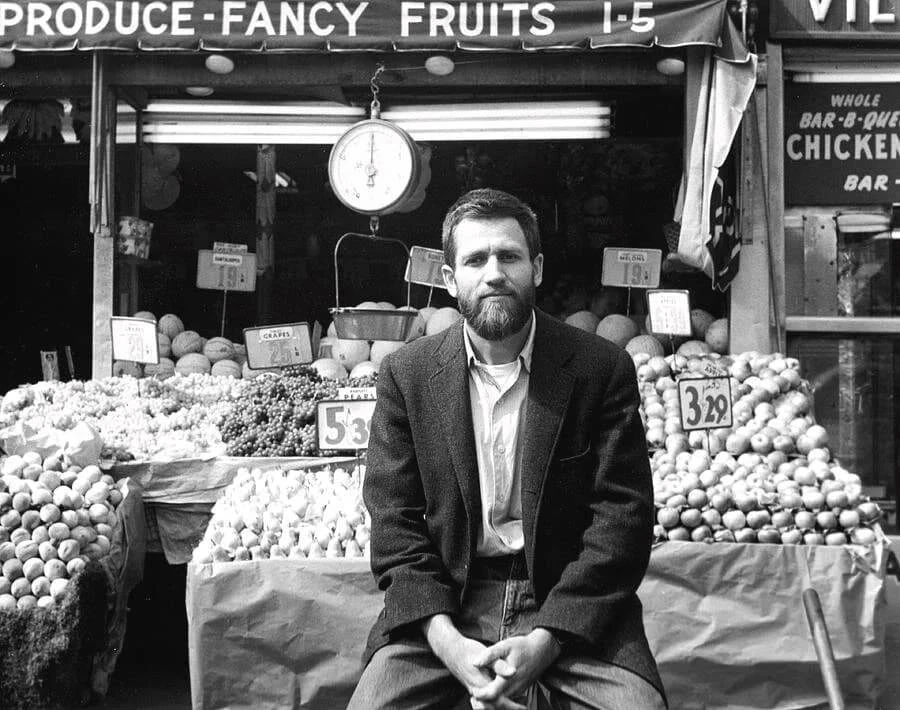
Allan Kaprow. He started out as a painter and became a revolutionary.
His path began quite traditionally. Kaprow studied with the legendary Hans Hofmann, a painter and one of the pillars of Abstract Expressionism. He absorbed the principles and mastered the technique. But the confines of the canvas quickly became too confining.
A real turning point came with his studies with the avant-garde composer John Cage at the New School for Social Research in New York. Cage created music from silence and chance. It was he who pushed Kaprow toward his fundamental idea: art can be anything. At the same time, Kaprow taught art history and theory at Rutgers University in New Jersey, where he gathered a group of like-minded individuals who would later be called the "Rutgers Group." 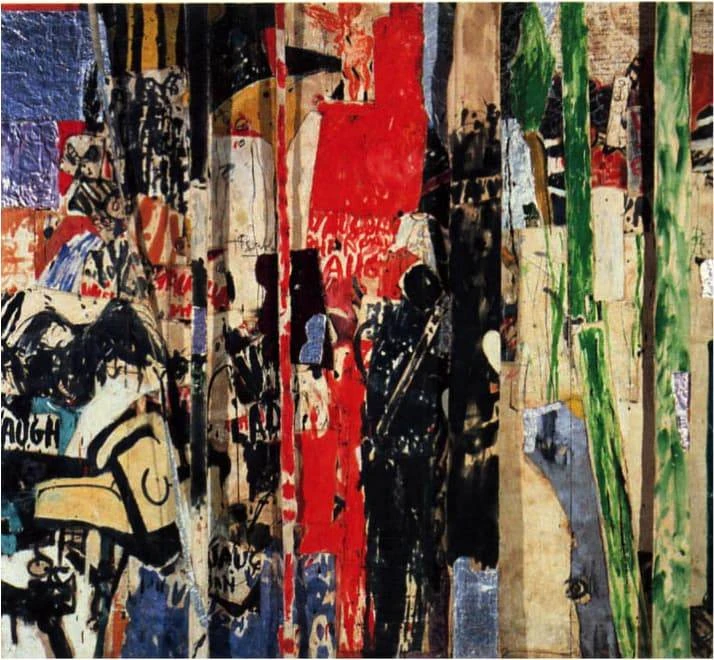
"Baby," an early work by Kaprow. Paper, foil, oil, synthetic paint, chalk, rope—the canvas was already bursting at the seams.
In October 1958, ARTnews magazine published an essay, "The Legacy of Jackson Pollock." In it, the young artist declared the death of traditional painting. Pollock had "introduced" chaos and movement into the painting—the next step would be a complete rejection of paint in favor of reality. Kaprow demanded a "concrete art" made from real things: chairs, food, electric lights, water, old socks, living beings. It was in this text that the word destined to change culture was first heard: "happening."
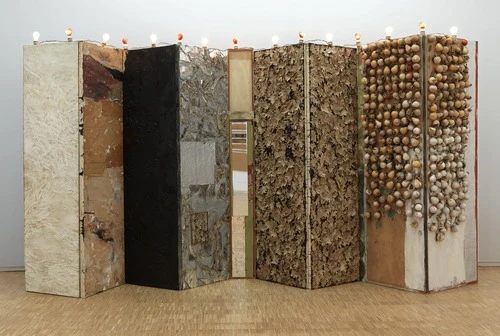
"Rearrangable Panels." Oil, leaves, plastic fruit, mirrors, light bulbs—the line between painting and life is blurred.
When the viewer becomes part of the canvas
On October 4, 1959, Kaprow showed "18 Happenings in 6 Parts" at the Reuben Gallery in New York. This was not an exhibition in the traditional sense. The gallery was divided into three rooms by translucent plastic partitions. For each three parts, six simultaneous actions unfolded in different spaces.

"18 Happenings in 6 Parts," Reuben Gallery, New York, October 1959. Only 75 people were invited to the premiere.
Everything was happening here at once. A woman concentrated on squeezing orange juice. Performers shouted nonsense syllables. Someone monotonously lit matches. Artists painted directly on canvas. Among the participants were Lucas Samaras and Robert Whitman, Rutgers students—men who would later make their own mark on the history of modern art.
The most radical aspect was the audience's position. Each of the 75 invited guests received a program and three stapled cards with instructions. The rules were strict: change rooms at the sound of the bell, do not applaud after each movement—only after the sixth, if desired. The audience became the "material" of the work. Kaprow didn't just show art—he made people experience it.
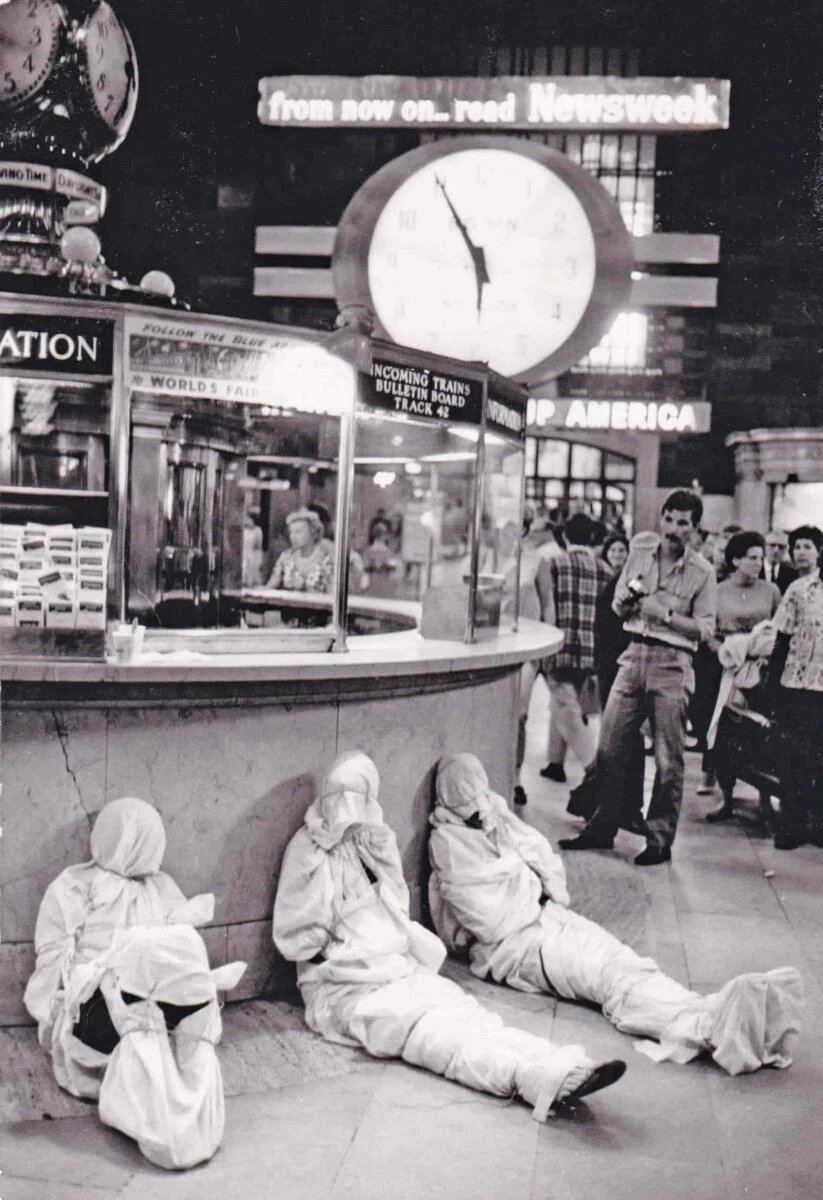
"Calling," 1965. Participants were wrapped in foil and left in public places.
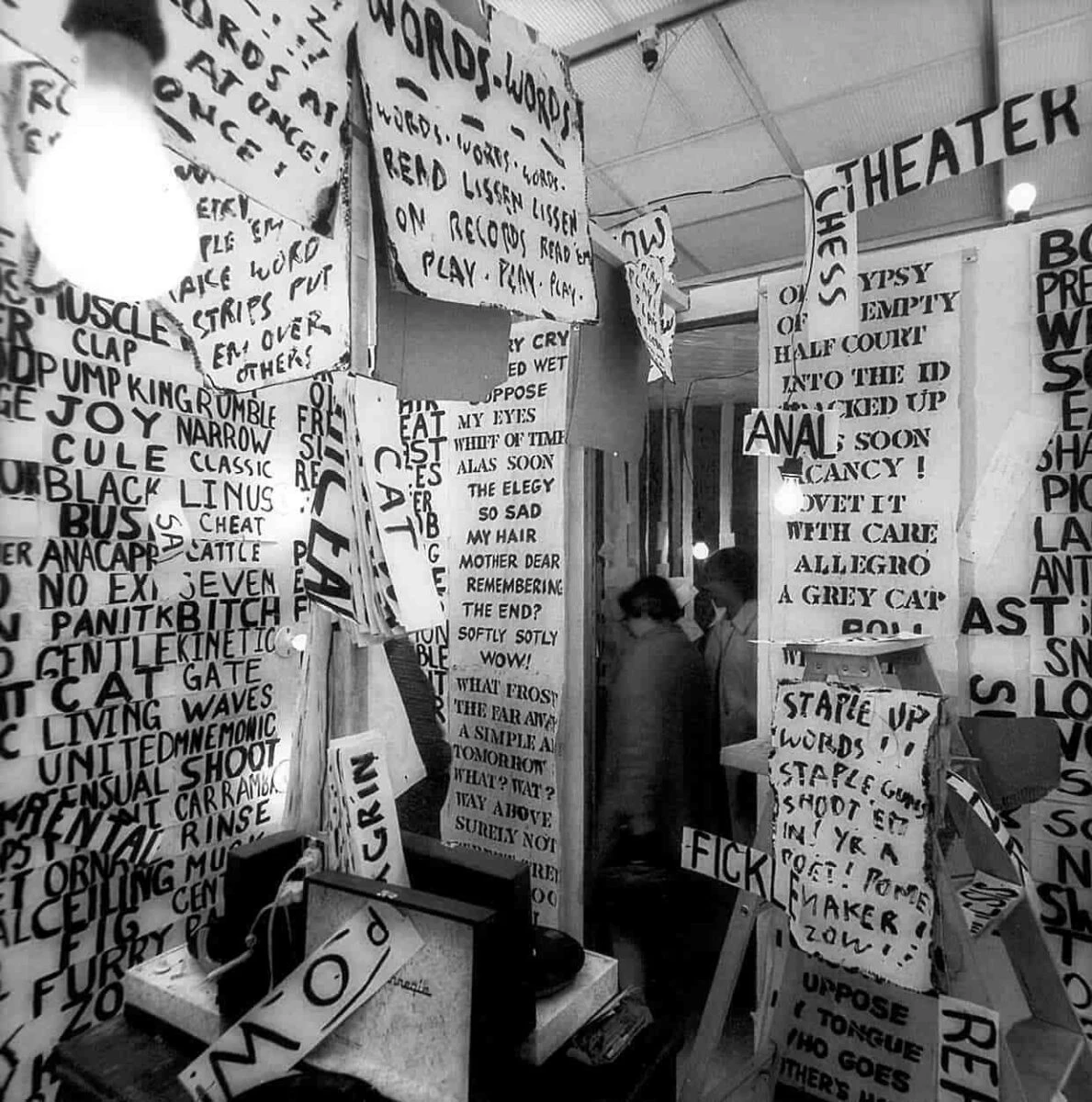
"Words," 1962. Viewers could write and erase words on the walls—the text became alive.
Tires, Bread, and Ice: Art from Trash and Food
With each passing year, Kaprow's performances grew larger and more absurd. In 1961, he created "Yard" in the sculpture garden of the Martha Jackson Gallery in New York. Beforehand, the existing sculptures—including works by Barbara Hepworth and Alberto Giacometti—were covered with protective tar paper. Hundreds of old car tires were piled on top. The public was invited not to contemplate sedately, but to climb, move, and throw them. They could smell the rubber and feel the instability of the surface. It was a tactile, raw experience—as far removed from the sterility of museums as possible.
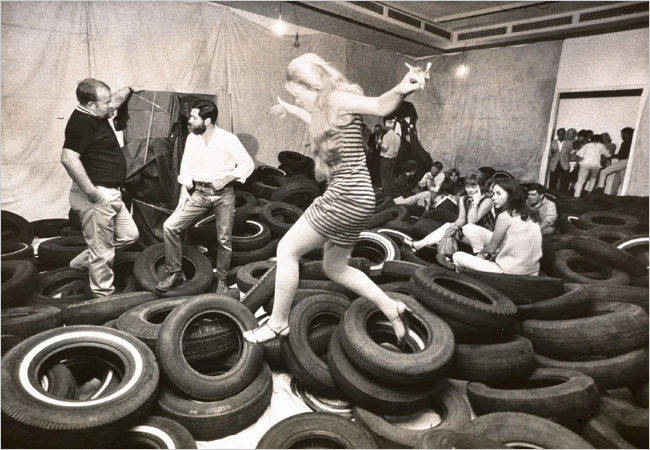
"Yard," 1961. Hidden beneath the tires are sculptures by Hepworth and Giacometti.
In November 1970, Kaprow erected "Sweet Wall" in West Berlin. The action was organized by the René Block Gallery. On a vacant lot near Köthenerstrasse in Kreuzberg—not far from the actual Berlin Wall—a small group of participants constructed a wall of cinder blocks approximately 30 meters long and 1.5 meters high. Instead of cement, they used slices of fresh bread spread with strawberry jam. Kaprow himself later called it a "political parody": the fragile, sweet structure parodied the reinforced concrete reality of a divided city. After construction was completed, the wall was torn down.
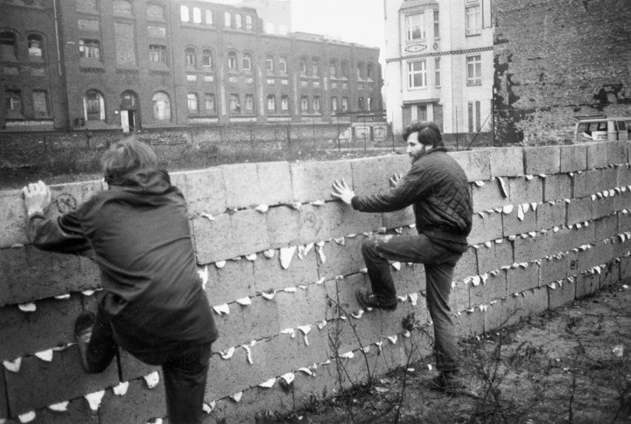
"Sweet Wall," Berlin, November 11, 1970. Bread and jam instead of cement—a parody of the Berlin Wall.
Ice Houses That Melt
In October 1967, Kaprow staged the "Fluids" performance in Pasadena and Los Angeles. About 20 rectangular structures made of ice blocks—each approximately nine meters long, three meters wide, and almost two and a half meters high—rose in various locations around the city. Volunteers built them according to a simple "invoice" posted on billboards: build the walls, don't put a roof on them, let them melt. Actor and photographer Dennis Hopper photographed the action.
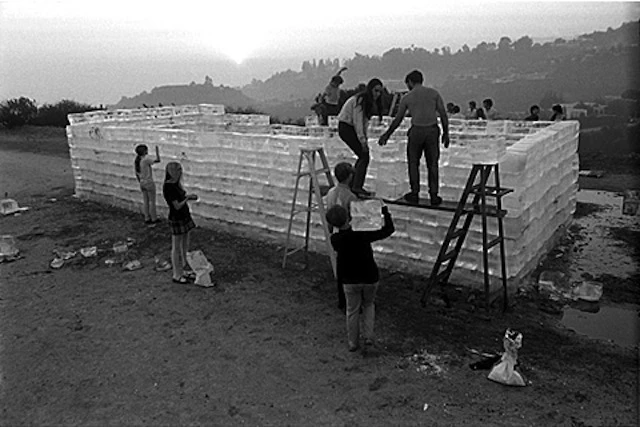
"Fluids," Pasadena, October 1967. Ice blocks—no roof.
It was a reminder: art doesn't have to last forever. The ice melted under the California sun—and nothing remained of the work. Only the memories of those who saw it.
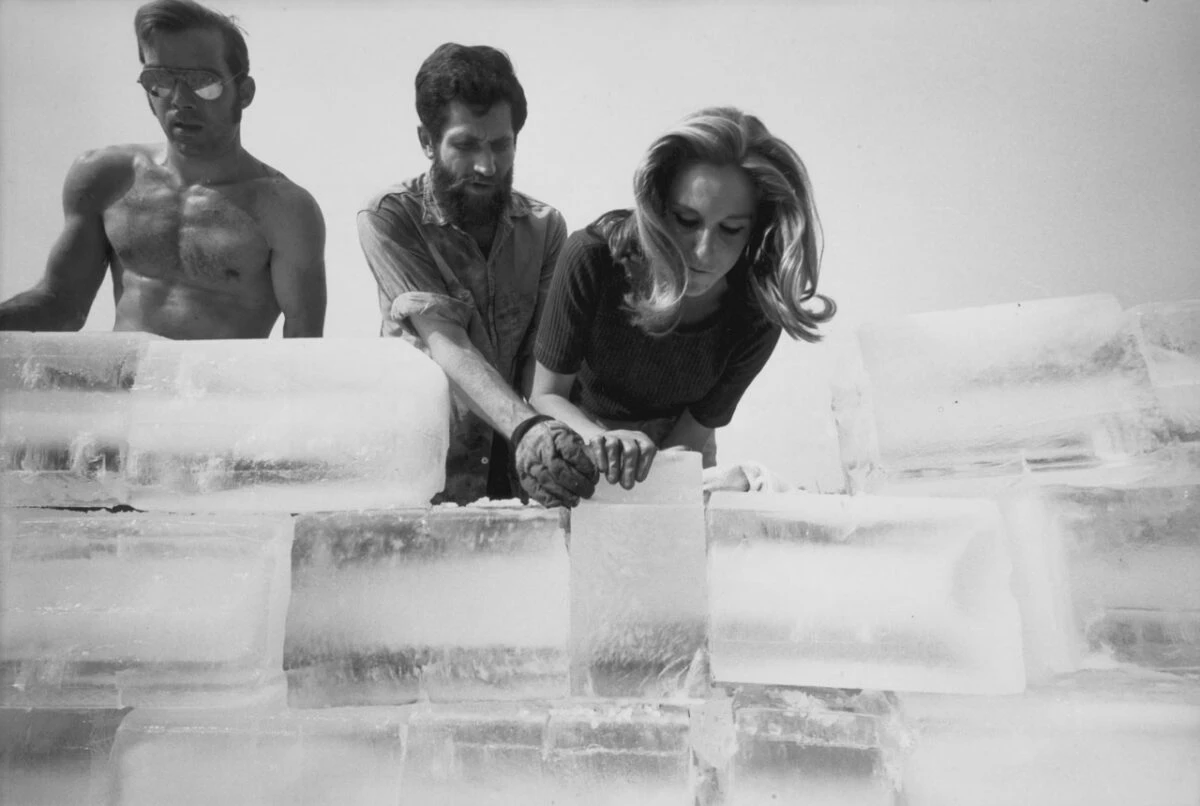
The ice is melting. That was precisely what art was—not an object, but a process.
During his life, Kaprow organized about 200 such events. Each was unique and could not be repeated exactly—this was fundamental.
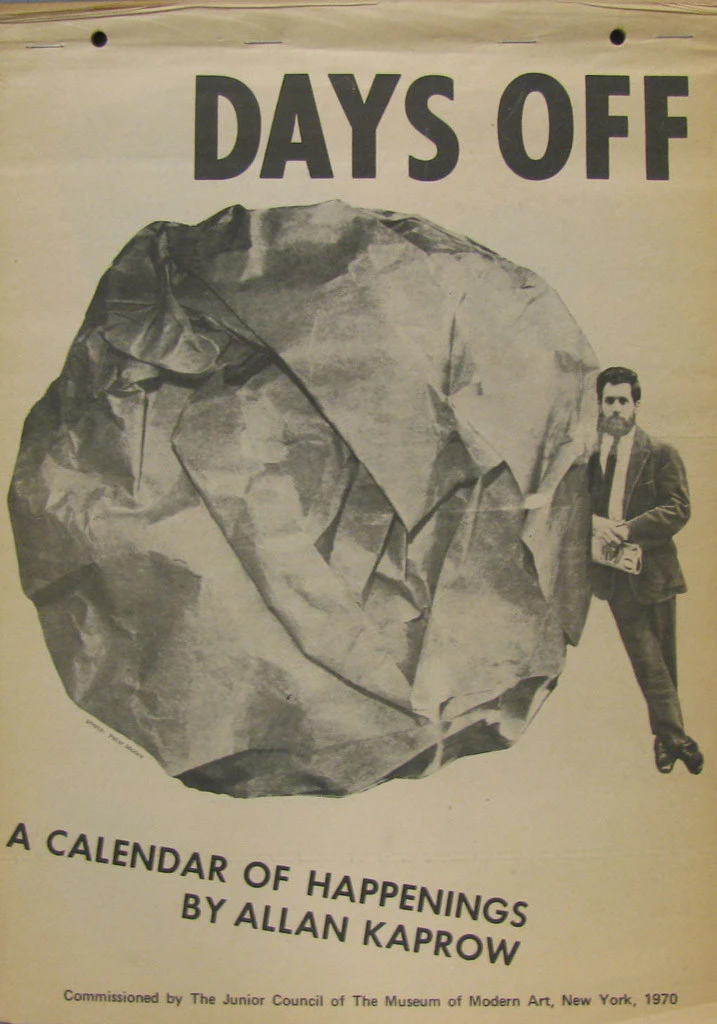
Allan Kaprow's Happenings Calendar. The Museum of Modern Art, New York, 1970.
Dirt as Currency
In 1983, Kaprow launched the "Trading Dirt" project. The idea seemed absurd: a grown man walking around with a bucket of dirt and offering to trade. But by then, Kaprow had long since moved away from large-scale public actions to intimate "activities"—quiet, almost invisible actions performed by one or a few participants.
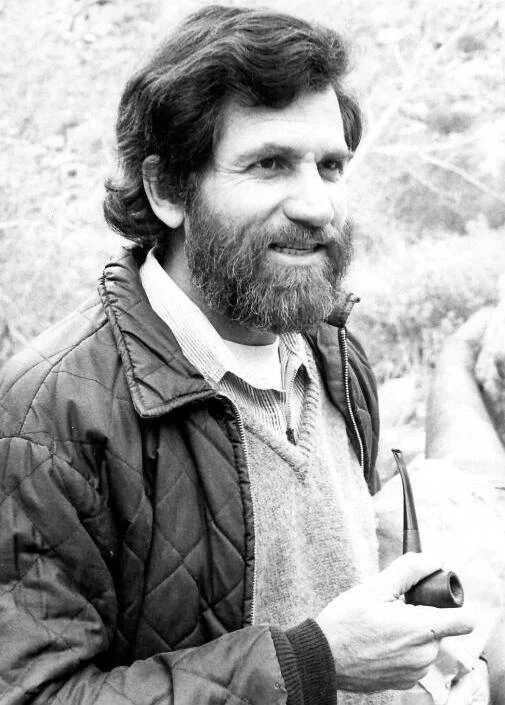
Allan Kaprow in his later years. From grandiose actions to quiet, personal gestures.
The first step was deeply personal. Kaprow studied at the San Diego Zen Center and brought a bucket of soil from his garden. The exchange of garden soil for soil from the spiritual center became an act of uniting the mundane and the sacred.
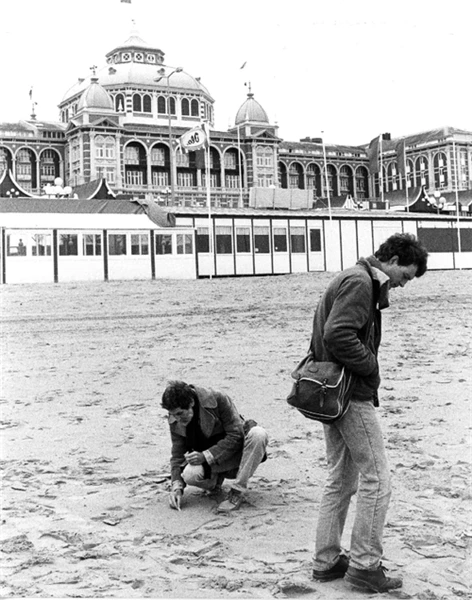
"Trading Dirt," San Diego Zen Center courtyard, 1983. Soil from the artist's garden met with soil from the meditation site.
He gave the soil he received from the Zen center to friends. They offered "dog dirt" in exchange—soil from the site where they buried their beloved German Shepherd. At that point, the project ceased to be an intellectual exercise. The bucket of earth became a vessel of memory: it contained grief, loyalty, years of friendship between man and animal. Each subsequent participant added to the physical weight—the weight of other people's stories.
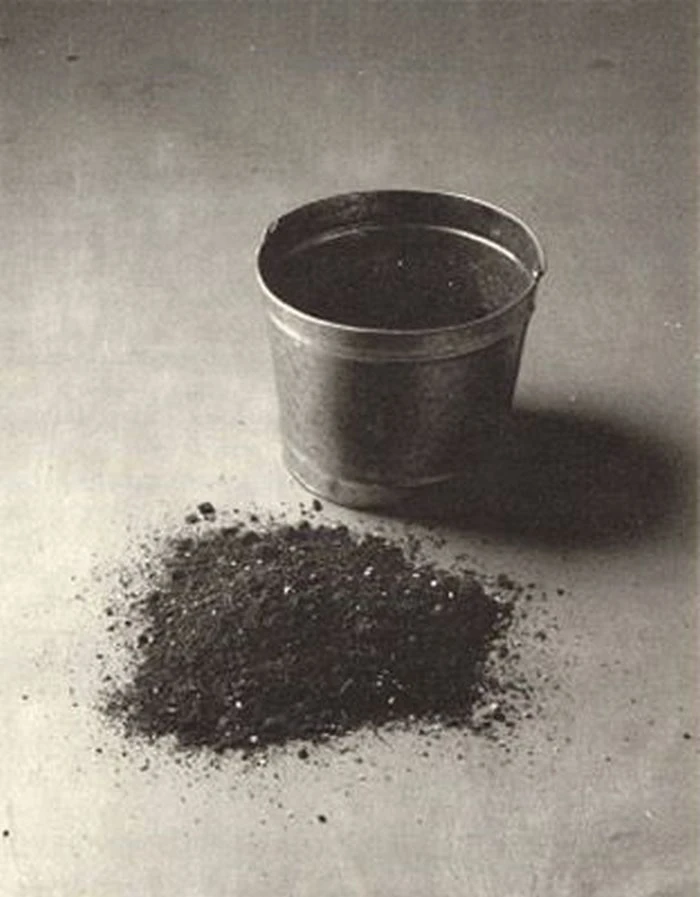
"Dirt Exchange," 1983. Earth as a carrier of someone else's memory and someone else's pain.
Earth is the foundation. That from which we came and to which we return. In the art market, the value of an object is determined by rarity or the artist's name. Here, the value was the act of exchange itself and the story carried within the soil.
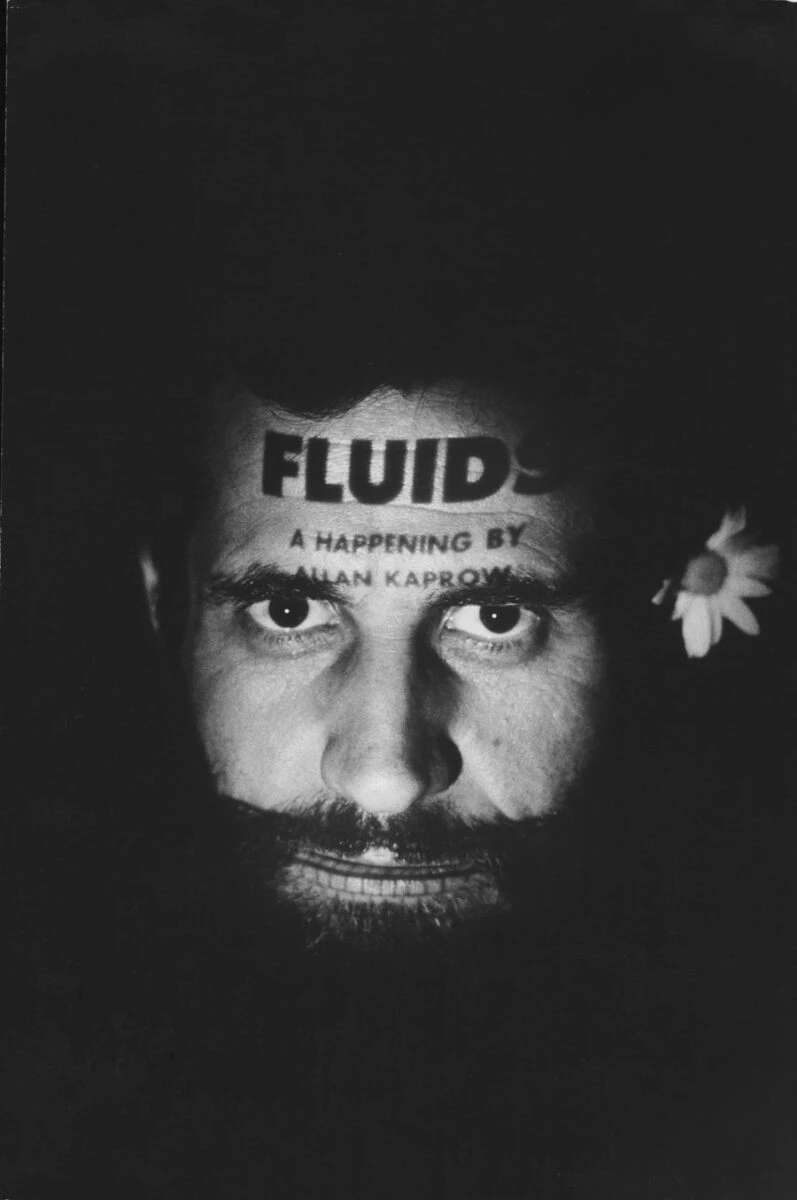
Poster for "Liquids," 1967. Kaprow published detailed "scores" of his actions—they were available for anyone to reproduce.
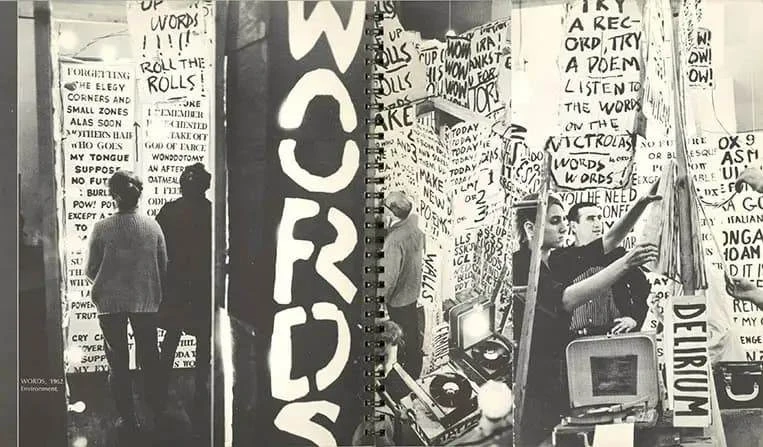
Exhibition brochure, 1967. Kaprow documented the events so they would live on after him.
When the Word Goes Popular
By the mid-1960s, the term "happening" had taken on a life of its own, breaking away from its creator. The word became fashionable – it was associated with youth culture, freedom, and parties. In 1967, The Supremes released the song "The Happening" – it reached number one on the US Billboard Hot 100 chart, becoming the band's tenth #1 hit. Advertisers of Maidenform bras played on the term in slogans.
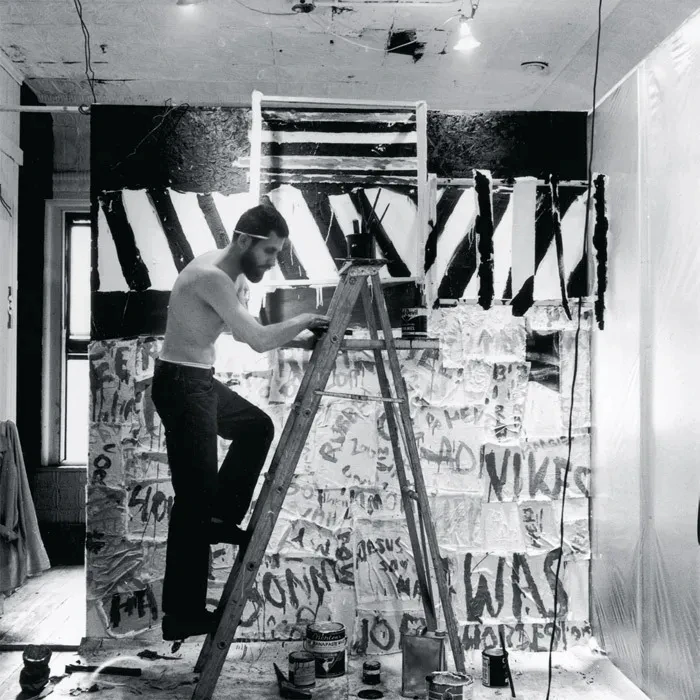
Kaprow at work, late 1950s. He didn't yet know then that the coined word would become popular.
Kaprow himself was furious. For him, a happening was a strictly controlled, almost ritualistic structure, not a chaotic get-together. He saw this as a devaluation of the idea. But it was precisely this "discontinuation" that proved how powerful his contribution had been.
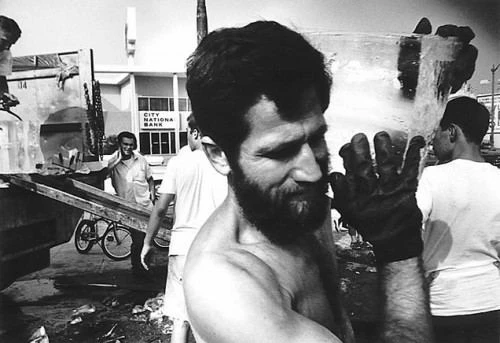
Kaprow personally participated in every performance—art was not delegated.
Kaprow's work anticipated installation, Fluxus, and all contemporary performance art. Today, it's hard to imagine the work of Marina Abramović or Yoko Ono without his ideas. He proved that to be a great artist, you don't need to be able to draw. It's enough to see art in a piece of bread or an old tire.
Do you think squeezing orange juice or walking on tires can be considered art? Or should art remain confined to paintings and sculptures?

Download
Archive size 2.42 Mb, downloaded 7 times