I'm an artist - that's how I see it! (9 photos)
Human nature is invariably drawn to that which is shrouded in an aura of mystery and illicitness. Some people, driven by curiosity, are willing to risk their own health to peer behind the veil of the forbidden. 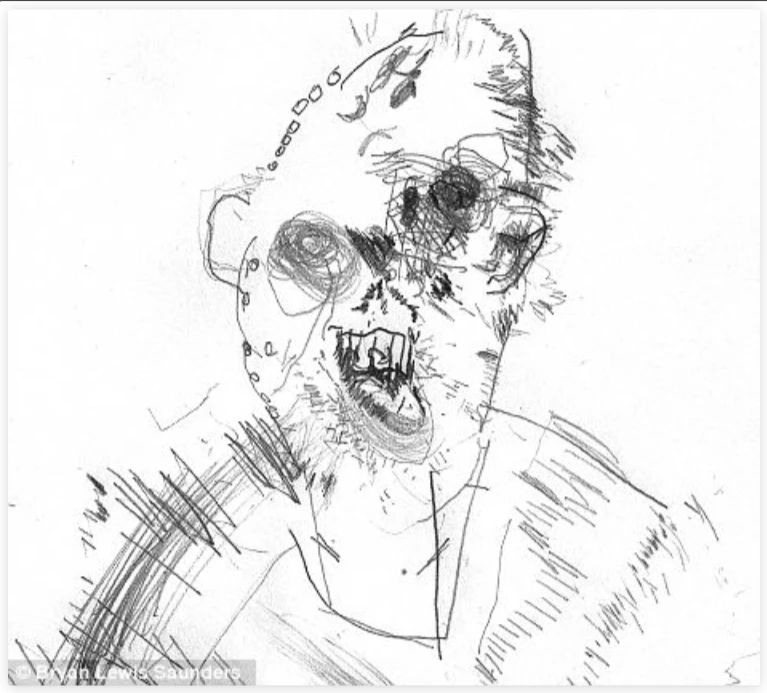
Such experiments with their perception of reality are often conducted by creative people, including artists, who decide to explore how drugs "expand their consciousness" and transform their vision of the world around them.
One such experimenter was Washington-based artist Brian Lewis Saunders, who created an entire portfolio of self-portraits painted under the influence of various "curious" drugs. 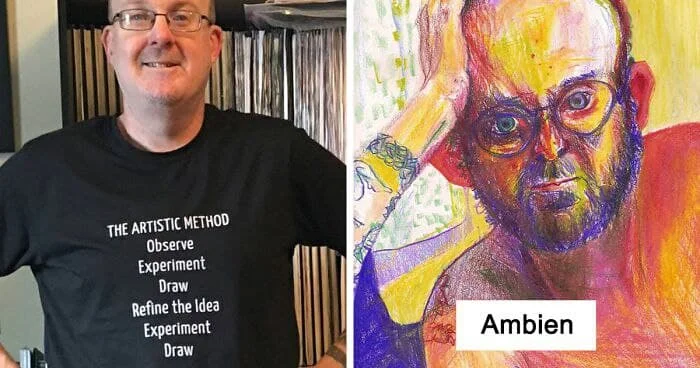
Brian Lewis Saunders
In March 1995, Saunders vowed to create a new self-portrait every day for the rest of his life. This decision alone seemed like a complex experiment, but in 2000, he decided to complicate (or perhaps simplify?) his experiment and create a radical (read: crazy) sub-series within the project – painting self-portraits under the influence of various drugs capable of influencing consciousness and altering perception of the world. Thus, Saunders created a portfolio with the succinct and pithy title "Under the Influence."
"Having experienced radical changes in my environment, I began searching for other experiences that could profoundly impact my perception of myself. So I devised another experiment in which I would take a new drug every day and expose myself to its influence." Brian Lewis Saunders
After a few weeks of his bizarre experiment, Brian suffered mild brain damage and became a frequent hospital guest. However, this didn't stop him, and he continued painting.
The artist sought new "experiences" in a wide variety of drugs—from cocaine and marijuana to Xanax and absinthe. Some of the results of this shocking experiment are below. And these results are truly thought-provoking. But...
But "was there a boy?"
As it turns out, the list of supposedly mind-expanding drugs included many that, according to experts, couldn't have such a powerful effect on the human brain and our perception of the world.
And unsurprisingly, there were many skeptics who claimed that Saunders didn't use anything, or at least didn't use everything he claimed. And, in fact, the whole thing was a hoax and a scam, purely for self-promotion.
"This is complete nonsense. I doubt he took any drugs. He's doing this for the PR, which he got. Cephalexin is an antibiotic, not a psychoactive substance. Trazodone is a very mild antidepressant, and again, not very psychoactive."
I'm a nurse, and these drawings are a scam. Many of the medications listed, as others have already said, are practically ineffective, and, of course, most of them are ineffective enough to significantly impact mental health.
Cefalexin/Keflex is a combination drug for the treatment of bacterial infections... Cephalexin treats infections caused by bacteria, including ear, skin, and urinary tract infections. I've taken it more times than I can count, and so have my children. We've never had a good time...
Although, it's possible that relatively "harmless" medications themselves could have some side effect when combined with other medications, or could have had some effect "on a body already exhausted by Narzan" (i.e., long-term use of all sorts of nasty stuff). Who knows? As far as I understand, many skeptics didn't bother to test it themselves. Alas. 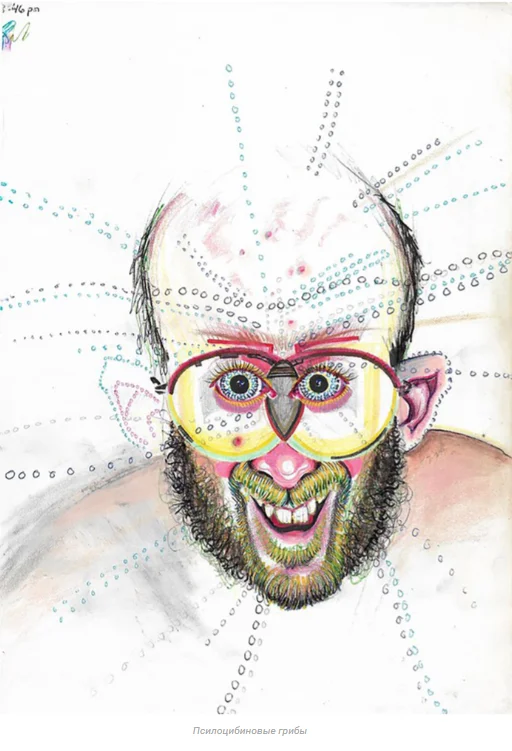

Drawing after taking psilocybin mushrooms.
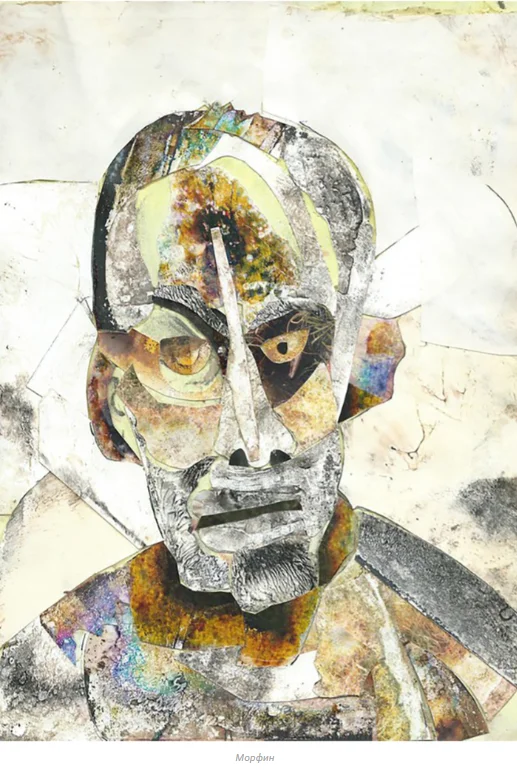
Drawing after taking morphine.
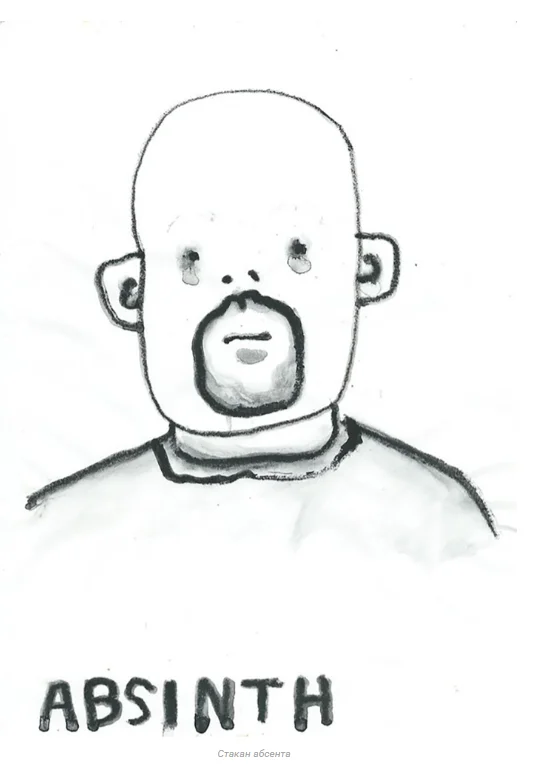
Drawing after drinking a glass of absinthe.
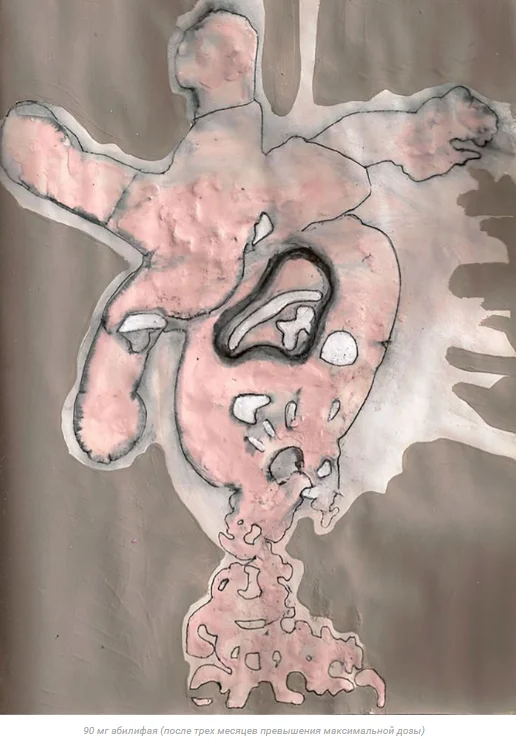
Drawing after drinking 90 mg of Abilify.
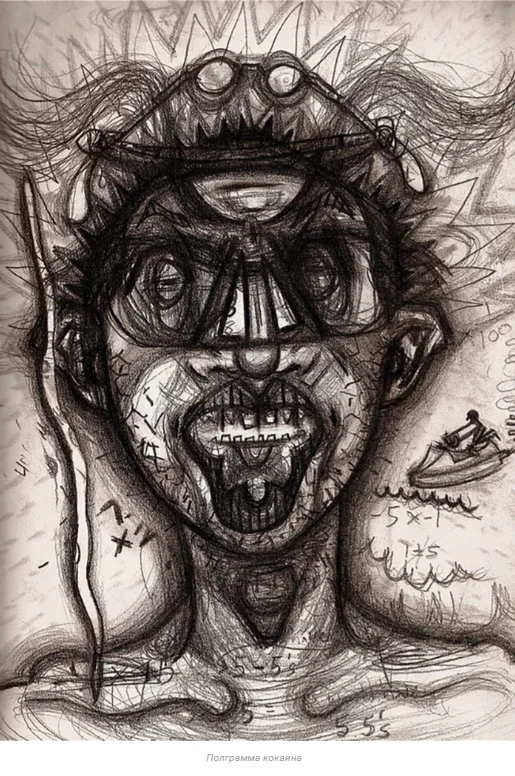
Drawing after taking 0.5 grams of cocaine.
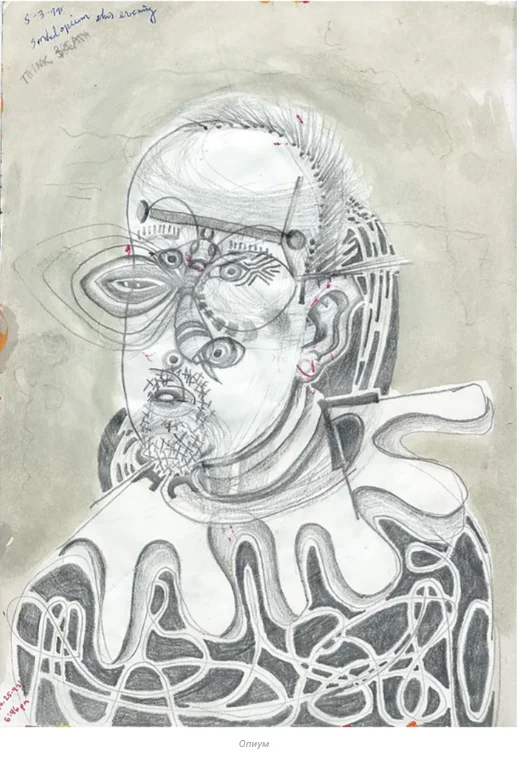
Drawing after taking opium.
However, I think the truth is somewhere in the middle, and I fully admit that the artist could have taken some narcotic drugs that do affect consciousness, especially since drug use is quite common in creative circles. But, obviously, the list of drugs was not as extensive as Saunders claimed.
Of course, Saunders was far from the first and far from the only one to undertake such "creative" experiments.
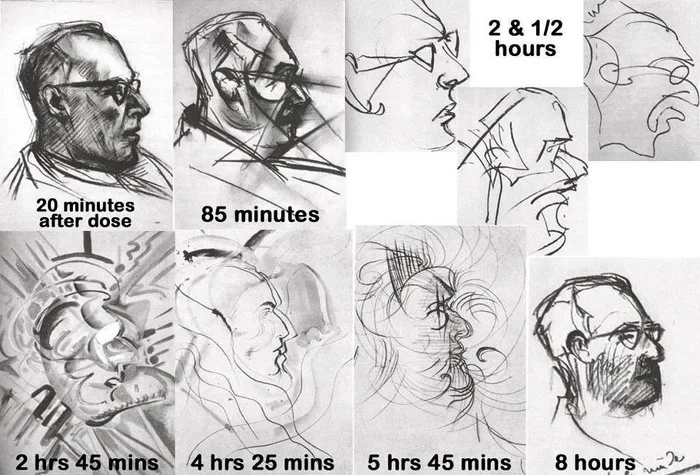
For example, back in the 1950s, Oscar Janigar, an experimental psychiatrist at the University of California, conducted research on the effects of LSD on human consciousness. He was interested in how the drug could be used to "open" the human mind and enhance creative potential.
During his experiments, he discovered that under the influence of LSD, artists used brighter colors in their works, and their paintings also turned out much more abstract than usual.
Just how abstract can be clearly seen in the photo below. It is a series of portraits of the same person, painted by the same artist at certain intervals after taking LSD.
It should be noted that psychiatrists and artists weren't the only or primarily concerned with the effects of drugs on the human mind. Intelligence agencies from various countries showed no less (if not many times greater) interest in this topic.
While the former (psychiatrists and artists) pursued, so to speak, purely "humanitarian" and creative goals in these experiments, the latter (intelligence agencies) had far more prosaic and pragmatic goals – control of human consciousness, manipulation, and complete subjugation of the human mind to another's will. To achieve their goal, the intelligence agencies and their agents stopped at nothing, using ordinary people as guinea pigs for monstrous experiments.
One of the most famous and controversial projects studying methods of manipulating human consciousness was Project MKUltra, which was supervised by the CIA in the United States and Canada. You can read about this project here: "We Didn't Just Break Mental Health—We Erased Personality": The Dark Story of How the CIA Turned Americans into Guinea Pigs.

Download
Archive size 1.11 Mb, downloaded 56 times